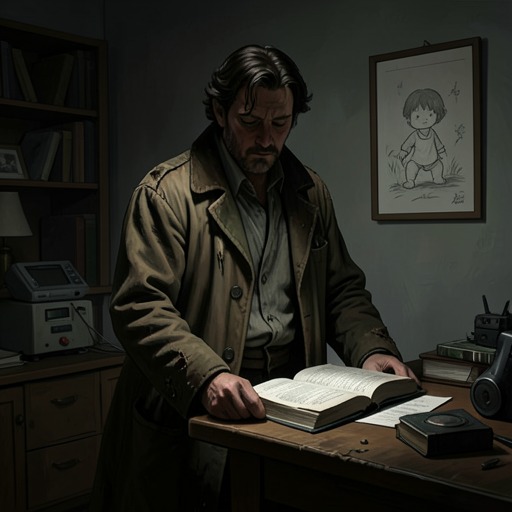
Bernarda
The Shadow of the WindBernarda, the housekeeper in Gustavo Barceló’s household and aunt to Clara Barceló, is a survivor who turns hard-won security into care for others. She welcomes Daniel Sempere into the Barceló home as a child, becomes one of the adults who watches over him, and eventually builds a family with Fermín Romero de Torres. Her story connects private survival to the book’s wider account of friendship, shelter, and the lives people make after violence.
Identity and Background
Bernarda introduces herself to Daniel when he first visits the Barceló residence, addressing him formally as Master Daniel and offering her service. The ceremonial manner is part of her welcome, but her authority in the house is practical as well: she guides the boy through its rooms and helps him find his way to Clara. Daniel sees her first as a stern-looking maid; time reveals the affectionate instinct behind that appearance.
Her arrival in Barcelona followed a flight from poverty and an abusive father in Cáceres. Gustavo Barceló found her working at a vegetable stall in the Borne Market and offered her a position in his household. That chance encounter provided a route out of her former circumstances and into a comparatively secure home. Barceló announced that he would make her his version of Eliza to his Professor Higgins, an allusion Bernarda met with independence rather than deference: she insisted that poverty and limited education did not make her indecent.
Bernarda’s background informs her directness, but the novel does not reduce her to it. She has little appetite for literature beyond the church newsletter, and she is not presented as an aspiring copy of her employer. Her sense of dignity rests instead on her own standards and on the care she offers within the household.
A Maternal Presence in the Barceló Household
As Daniel begins spending time at the Barceló home, Bernarda grows fond of him and decides, in her own way, to adopt him. She tells Barceló that the boy has no mother and that she feels sorry for him. Her attention gives Daniel an additional source of adult affection during a childhood in which his longing for Clara often leaves him suffering in silence.
Her kindness takes a social as well as an emotional form. When she comes to the bookshop to choose a present for her niece from San Adrián, she explains that she wants a substantial book, with plenty of writing and few pictures, but does not know how to choose one. The visit shows her trying to pass on a gift through reading even while she describes herself as a person without much learning. It also brings her into closer contact with Fermín, who appears amid a cascade of books and quickly becomes part of her story.
Bernarda’s care is not confined to Daniel. During Fermín’s recovery after a violent episode, she waits anxiously as he is carried into the Barceló building. When the doctor confirms that he will live, Barceló comforts her and helps her to the kitchen. Later, despite being exhausted and affected by brandy, she disregards Barceló’s instructions to stay away and lies down beside Fermín. He, bandaged and badly bruised, holds her tenderly as she sleeps. The scene makes their attachment visible through reciprocal care rather than declarations: she keeps vigil, and he reaches for her even while injured.
Relationship with Fermín
Fermín’s gratitude to Daniel and Daniel’s father for taking him in does not displace his bond with Bernarda. He speaks of taking her out and says he will spare no expense on her behalf; even a grand claim about robbing the Central Bank is comic exaggeration, but the underlying devotion is plain. His concern for Bernarda also shapes his conduct when Daniel is distressed. Planning an outing for the younger man, Fermín first considers what Bernarda will say, then explains that he will wait outside while Daniel goes in, because his own commitment is to monogamy in practice.
Their relationship is recognized openly by Barceló. When he finds Fermín in bed with Bernarda, he points out that she is old enough to decide for herself and asks Fermín what kind of charade he and Daniel are involved in. Fermín answers that his intentions toward her are honest. Bernarda is not treated as property to be granted or withheld; Barceló makes clear that the choice belongs to her, while Fermín’s words place the relationship within a promise of seriousness.
Fermín later tells Daniel that being taken off the streets gave him a new beginning, and Daniel responds that Fermín is his best friend. In their exchange, friendship and rescue are closely linked: Fermín remembers the debt he owes Daniel and his father, while Daniel affirms that Fermín deserves his friendship. Bernarda belongs to the same network of mutual loyalty, not merely as the person Fermín loves but as someone whose presence makes a future beyond survival possible.
Care, Crisis, and Family
Bernarda’s response to crisis is immediate and concrete. When Daniel, Fermín, and their companions arrive covered in blood and dirt, she is waiting at the building with Barceló and Dr. Soldevila. She screams in alarm when she sees them, then remains involved as Fermín is carried upstairs and the doctor begins treating him. Once the physician says Fermín will live, Bernarda breaks down, grieving the prospect that the good man she has found may be taken from her. Barceló leads her away and gives her brandy while she cries.
Her care continues after the immediate danger has passed. When Daniel later visits, she has been with Clara all afternoon; Clara reports that Bernarda has been talking about him and says Bernarda thinks he looks handsome and grown up. The comment joins two strands of Bernarda’s role: she remains attentive to Daniel’s development, and she is close enough to Clara to share ordinary conversation about him. Her affection is familial without being sentimentalized; it appears in the attention she gives and the way she keeps people connected.
The final account of her life supplies the outcome. Bernarda and Fermín marry in 1958 and have four sons, all of whom inherit their father’s prominent nose and ears. The detail carries the household’s comedy into the next generation, while the marriage itself completes a story that began with a woman escaping an unsafe home and a man being rescued from the streets. Their family is not a cure for the past, but it is a durable life made together.
Narrative Role and Significance
Bernarda’s story is structured through acts of welcome. She greets Daniel at the Barceló residence, takes him under her wing, and later becomes part of the circle that receives him and Fermín in crisis. In each case, the household is more than a setting: it offers shelter, food, and the ordinary care that makes intimacy possible. Bernarda helps create that refuge through domestic labor and emotional attention, even when the narrative does not make those forms of work grand or conspicuous.
Her relationship with Fermín also counterbalances his history of homelessness and persecution. His public manner can be extravagant, but Bernarda’s importance is shown most clearly in quieter scenes: her alarm when he is brought in, her decision to stay beside him, and their eventual marriage. Their bond turns the idea of being taken in into a shared future. Alongside her maternal affection for Daniel and her closeness to Clara, it establishes Bernarda as a steady presence in a novel where many characters have been separated from family or deprived of safety.